
Nothing calls home.
Start there, and check the rest.
The questions a carrier's procurement and security teams ask are not the ones in a datasheet. They are about dependence: what leaves the building, who can see what, what happens the day the vendor is unreachable, and whether the platform will admit what it cannot see.
Most infrastructure buying decisions are reversed by a single discovery: that the thing you bought needs someone else to keep working.
The short answers
What crosses your boundary
NOC2 is a service we host — we would rather say that in the second sentence than let you find it in a diagram. What matters is which side of the boundary each thing sits on.
We checked this the way you should check it: by looking for outbound destinations compiled into the software, rather than by asserting a policy. The agent contains no address belonging to us at all — no licence server, no activation endpoint, no separate metrics sink. It reports to the console endpoint it was enrolled against, and that is the only place it talks to.
Which is the distinction that matters in a security review. A hosted console is a service you can evaluate, replace, or lose without consequence to traffic. A licence server in the forwarding path is a dependency you cannot escape. We have the first and not the second, and those are not the same risk.
Updates: signed, verifiable, and stoppable
An auto-updating agent across a fleet of gateways is either a great convenience or the most efficient way ever devised to break a network. The difference is entirely in who can authorise one.
Every release carries a signature
Agent builds are signed with an Ed25519 key, and an agent verifies the signature before it will install anything. An unsigned or tampered build is refused, not warned about.
The agent checks before it installs
Verification happens on your gateway, not on the server that offered the update. A build that fails the check is refused outright — there is no path by which an unsigned binary reaches your data plane.
One switch freezes everything
A single environment variable makes the server offer no update at all to any agent. During a change freeze, an incident, or an audit, the fleet simply stops taking new versions.
Be clear about what this does and does not protect. Signing guarantees that what installs on your gateway is the build we published, unmodified. It is not a claim that you control our release schedule — the freeze switch is what gives you that, and during a change freeze or an audit it is the control to use.
Who can see what
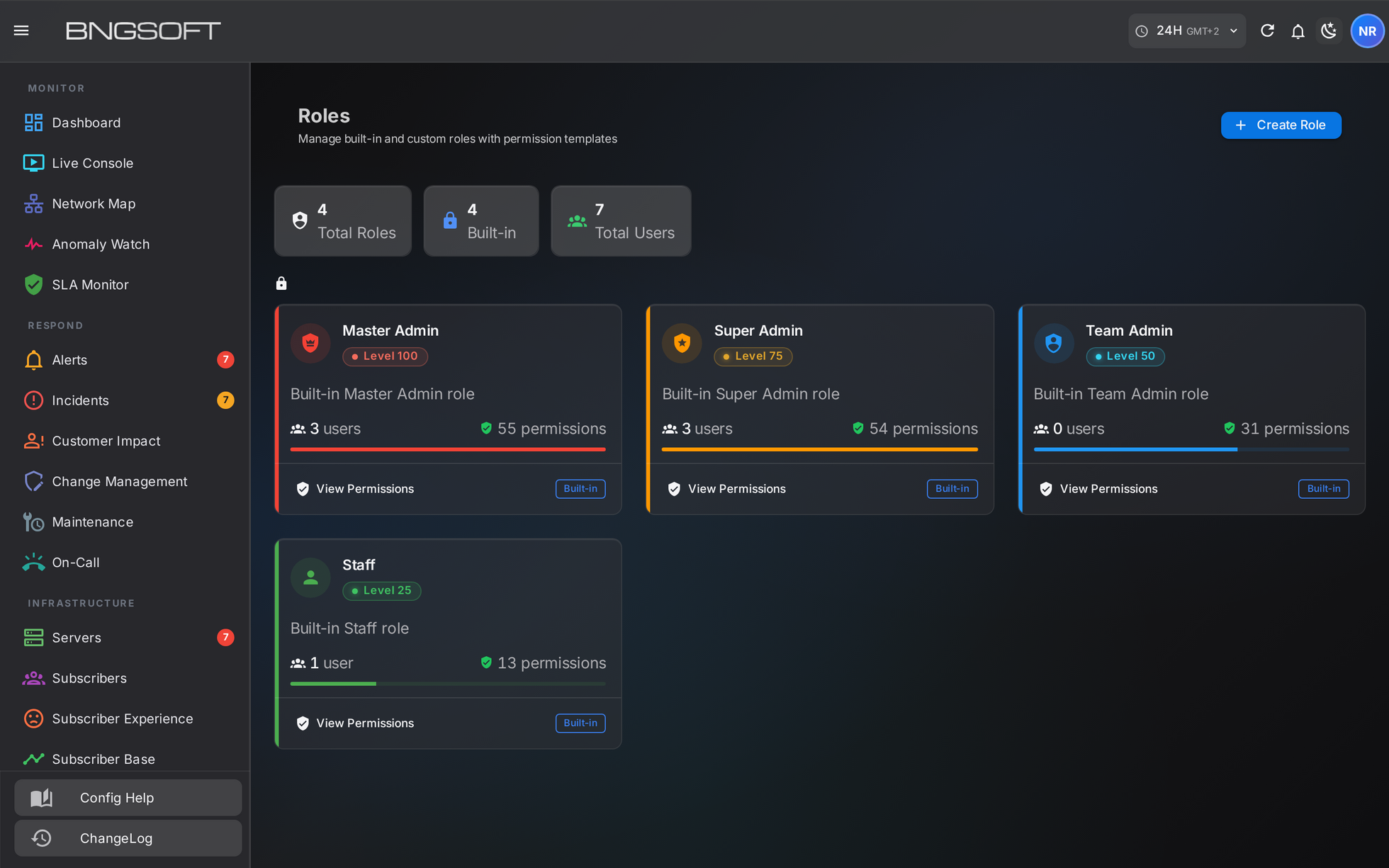
Access questions in an RFP are usually answered with the word "RBAC" and no further detail. The detail is the answer.
The platform states what it cannot see
This is the section we would most like a security reviewer to read, because it is the one that is usually missing.
Every monitoring system has blind spots: a collector that never ran, a probe deployed to half the estate, a gateway that stopped reporting last Tuesday. The dangerous property is not having them — it is presenting a number computed from a partial sample as though it described everything.
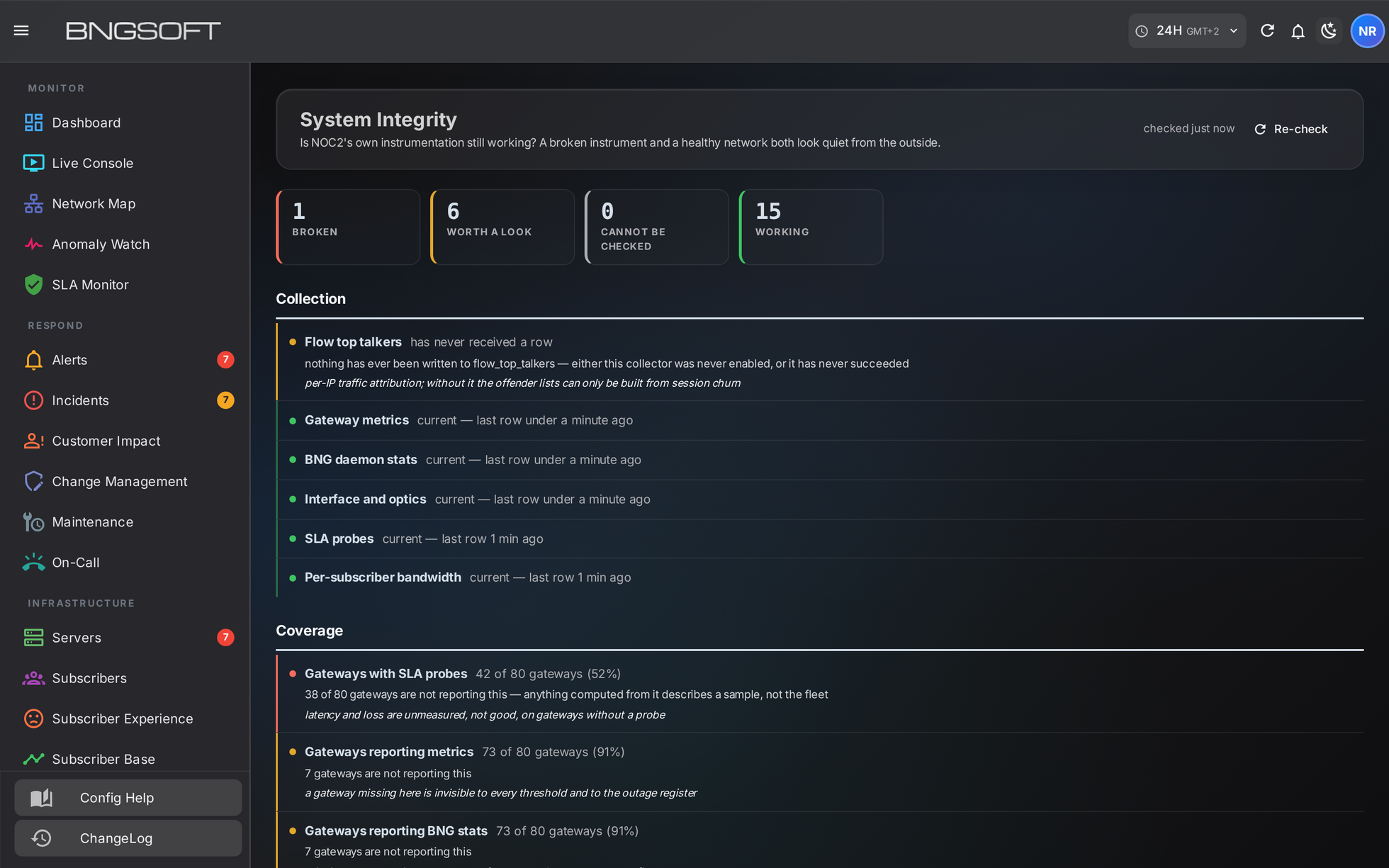
Ask every vendor on your shortlist for this screen. Not the dashboard — the page that says which parts of the dashboard are currently lying. If they cannot show you one, the honest reading is that their coverage gaps are invisible to them too.
Safety functions are never licence-gated
Commercial controls exist. They apply to capabilities, not to the things that tell you the network is on fire.
The failure mode we designed out
A licensing state changes — an expiry, a counter, a mistake in a record — and alerting quietly stops for the affected operators. The network keeps having problems; nobody is told about them.
This is a genuinely dangerous pattern, because the symptom of it is silence, and silence is indistinguishable from health.
The rule
Alerting, incident detection and the operational console are never gated by licence state. A commercial dispute may stop you enabling a new capability. It does not stop you being told a gateway is down.
Enforcement also carries an explicit switch, so the behaviour can be disabled outright rather than reasoned about.
What you are actually buying
| Dimension | Position |
|---|---|
| Deployment | Gateways on commodity x86 in your racks. The NOC2 console is a hosted service we operate. |
| Runtime dependency on the vendor | None in the data plane. No licence call, no activation, no heartbeat. Losing the console does not interrupt a single subscriber. |
| Subscriber data location | Telemetry is held in the hosted platform, scoped to your account. Subscriber traffic itself never leaves your network. |
| Update authority | Signed releases, verified on the gateway, with a fleet-wide freeze switch. |
| Access control | Four built-in roles plus custom roles; per-operator scoping of which gateways an account can see. |
| Instrumentation honesty | Self-audit page stating broken collectors and coverage as a fraction of the fleet. |
| Hardware lock-in | None. Standard servers and standard NICs; sizing is measured on the hardware you intend to buy. |
The bottom line
A supplier relationship should be a commercial arrangement, not a technical dependency. The test is simple, and you can apply it to every vendor you are evaluating: if they vanished this afternoon, what stops working?
Here the answer is: the console, and new software versions. Not forwarding, not authentication, not CGNAT, not the protection stack, and not a single subscriber session. The dependency is on the part you would replace, not on the part that carries your customers — and that is the distinction worth holding every vendor to.
About the screenshots. Every screen shown is a real production console. Gateway hostnames, operator names and site names are replaced with placeholders, and every address is replaced with one from the RFC 5737 documentation range, before the image is taken; no operator, site, region or subscriber identifier appears in any image.